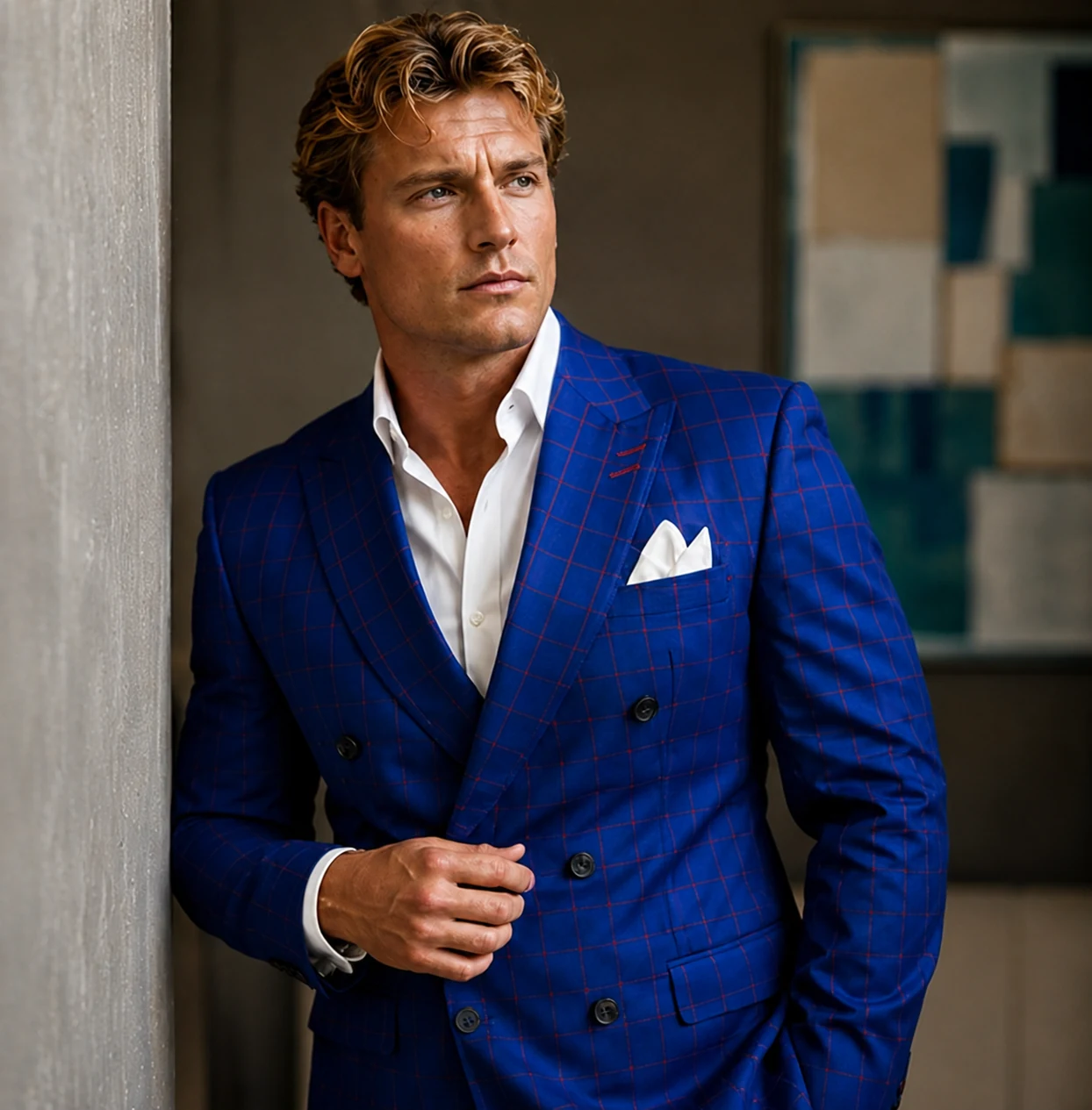
WAYTE BESPOKE DESIGN GUIDE
Choose with confidence.
Compare shapes, finishes, and details while you design. Your order selections stay in place.
This guide is currently available in English. Your language selection is saved.
Style illustrations show the differences between options. Fabric, color, and finishing follow your selections.
Jacket
Pants
Shirt
Pocket Square
The jacket, detail by detail. Start with the front and fit, then choose the details that frame it.
01 Front style & fit Single-breasted jackets have one column of buttons. Double-breasted jackets overlap more deeply and show two columns.
Single-breasted · 1 button A lower, simple fastening that leaves a longer opening through the chest.
Look for one front button.
Single-breasted · 2 buttons A balanced everyday choice for business, celebrations, and separates.
Look for two buttons in a single column.
Single-breasted · 3 buttons A higher closing front with more coverage through the chest.
Look for three buttons in a single column.
Double-breasted · 2 buttons A clean overlapping front with the simplest double-breasted button layout.
Look for one visible pair of buttons.
Double-breasted · 4 buttons An overlapping front with two rows of buttons and a more defined waist.
Look for two pairs of buttons.
Double-breasted · 6 buttons The fullest button arrangement, with a strong, traditional front.
Look for three pairs of buttons.
Choose the amount of room Fit changes the shape through the chest and waist. It should still let you move comfortably.
Slim Fit Closest through the chest and waist, with the most visible shaping.
Modern Fit Moderate waist shaping with more room than Slim Fit.
Classic Fit A straighter body with the most room through the chest and waist.
02 Lapels & buttonholes The lapel is the folded front edge that frames your shirt and face. Shape and width are separate choices.
Notch lapel An inward cut where the collar meets the lapel. A versatile choice for everyday tailoring.
Look for the small V-shaped notch.
Peak lapel An upward-pointing tip that draws the eye toward the shoulders.
Look for the tip pointing up and outward.
Shawl lapel One continuous rounded curve, often chosen for eveningwear.
Look for a smooth edge without a notch or pointed peak.
Lapel width Compare how much of the chest the lapel covers. These examples show the same notch shape.
Slim · under 2.5 in A narrower strip of lapel for a pared-back look.
Standard · 2.5 in A balanced width that keeps the jacket’s proportions restrained.
Wide · 3.5 in More lapel across the chest for a bolder appearance.
Lapel buttonholes A buttonhole is the small stitched opening on the lapel. It is separate from the jacket’s front fastening.
No buttonhole An uninterrupted lapel surface.
Single buttonhole One angled stitched opening on the lapel.
Double buttonholes Two parallel openings on the same lapel. This adds a second buttonhole, not another lapel.
03 Chest & side pockets Chest pocket This sits high on the wearer’s left side of the jacket.
Welt chest pocket A narrow, finished opening built into the jacket. The most understated option.
Patch chest pocket A visible pocket sewn onto the outside of the jacket for a more relaxed feel.
Side pockets Choose the treatment at the hips. All examples are shown at the same scale.
No side pockets A clean front without exterior side-pocket openings.
Flap pockets A fabric flap covers each opening. A familiar tailored-jacket finish.
Patch pockets Visible pockets applied to the outside. A natural partner for casual jackets.
Welted pockets Slim openings without covering flaps. A quieter, streamlined finish.
Flap + ticket pocket A smaller extra pocket above one hip pocket adds a traditional detail.
Look for the additional small flap above the main pocket.
04 Back vents A vent is an opening at the lower back of the jacket. It gives the hem space to move as you walk or sit. The gold circles mark the openings in these examples.
Single vent One opening at the center back. A simple, classic construction.
Look for the split along the center seam.
Double vents One opening at each side of the back. They allow the center panel to move freely.
Look for two side openings.
No vent A continuous back hem for an uninterrupted silhouette. It has less freedom to open when seated.
Look for a hem with no splits.
05 Sleeve buttons & hand stitching Sleeve buttons This is the number of buttons at each jacket cuff, independent of the buttons on the front.
1 button The simplest cuff detail.
2 buttons A compact pair at the sleeve opening.
3 buttons A slightly longer row of buttons.
4 buttons A full row with a traditional tailored appearance.
Hand-stitched edging Also called pick stitching: small stitches following the edges of the lapels, collar, chest pocket, and side pockets.
Single edge stitching One row close to the edge. Matching thread keeps it subtle.
Double edge stitching Two parallel rows following the edge. The second row makes the finish more visible.
Where it goes: Around the lapels and collar, and along the chest-pocket and flap-pocket edges. Wayte’s option does not add pick stitching at sleeve cuffs or back vents. Thread color changes how visible the stitches are.06 Lining & personal details Lining is the inner fabric of the jacket. Coverage changes how much of the inside is covered; color and pattern are chosen separately.
Unlined Most of the jacket’s inner shell and neatly finished seams remain visible.
Look for exposed inner cloth rather than a full lining panel.
Quarter-lined A small lining section around the shoulders leaves most of the back uncovered.
Look for limited coverage near the top.
Half-lined Lining covers the upper back while the lower back remains open.
Look for the lining ending partway down the back.
Fully lined Lining covers the inside body for a smooth, continuous finish.
Look for coverage extending down the inner back.
The pale lining highlights coverage in these examples. Your chosen lining color or pattern is a separate part of your design. Interior monogram Add initials or a short message inside your jacket. Check the spelling and choose a thread color before adding your design to the cart.
Your words, inside the jacket An interior monogram keeps the personalization discreet. Placement shown is an example.
07 Jacket sizing Choose the fit method separately from the silhouette. A Slim, Modern, or Classic fit describes the shape; your size or measurements determine the dimensions.
Off-the-rack Use a standard size from the chart below. For jackets, select Short, Regular, or Long as well.
Custom Measurements After checkout, you’ll receive a button to open a QR code. Scan it with your phone to start your measurement profile.
Jacket size chart · inches and centimeters Trousers with the right balance. Choose room and waist position first, then refine the front, pockets, and hem.
01 Fit & waist position Fit describes the room through the seat, thigh, and leg. Waist position describes where the waistband sits. Choose them separately.
Slim Fit A closer seat and thigh with a narrower lower leg.
Modern Fit Moderate room through the thigh with a gentle taper.
Classic Fit More room through the seat and thigh, with a straighter leg.
Where should the waistband sit? A different waist position changes the proportions of the outfit; it does not automatically change the fit.
High Waist Sits higher on the torso, closer to the natural waist. This creates a longer visible trouser line.
Low Waist Sits lower toward the hips. This leaves a shorter visible trouser line and more shirt above the waistband.
02 Pleats Pleats are folds just below the waistband. They open to allow movement through the front of the trousers.
No Pleats A smooth, flat front without extra folds.
Look for a clean front below the waistband.
Single Pleat One fold on each side adds room while keeping the front restrained.
Look for one fold on each side of the fly.
Double Pleats Two folds on each side add more fullness to the front.
Look for two folds on each side of the fly.
The long pressed line down a trouser leg is a crease. A crease can appear on trousers with or without pleats. 03 Waistband fastening Choose where the waistband closes and whether you want a visible button.
Centered Button A visible button at the center of the waistband, above the fly.
Offset Button An extended waistband tab places the visible button to one side of the fly.
Centered Buttonless Tab A centered closure with the fastening concealed beneath the tab.
Offset Buttonless Tab An extended tab with a concealed fastening for a clean overlap.
04 Back pockets Welt pockets are narrow openings; patch pockets sit on the outside; flap pockets have a fabric cover. The number tells you how many appear across the back.
No Back Pockets An uninterrupted back without exterior pocket openings.
One Welt Pocket + Button One narrow opening with a button fastening.
Two Welt Pockets + Buttons A matching welt pocket and button on each side.
One Patch Pocket One visible pocket applied to the outside.
Two Patch Pockets An outside patch pocket on each side.
One Flap Pocket One opening covered with a fabric flap.
Two Flap Pockets A fabric flap covers the pocket on each side.
05 Trouser hem The hem is the finish at the bottom of each leg. It is separate from the trouser’s final length.
Plain Hem — No Cuff A smooth edge with the excess fabric turned inside. A versatile finish.
Cuffed Hem Fabric turns up on the outside to form a visible band, adding weight and detail.
Trouser break describes how the fabric rests on your shoes. A plain or cuffed hem can be finished to your preferred length. 06 Pants sizing Choose the fit method separately from the silhouette. A Slim, Modern, or Classic fit describes the shape; your size or measurements determine the dimensions.
Off-the-rack Use a standard size from the chart below. For jackets, select Short, Regular, or Long as well.
Custom Measurements After checkout, you’ll receive a button to open a QR code. Scan it with your phone to start your measurement profile.
Pants size chart · inches and centimeters A shirt made personal. See what changes at the collar, cuffs, and back before choosing your details.
01 Fit & sleeve length Slim Fit Closer through the chest and waist, with the most shaped body.
Modern Fit A gently shaped body with comfortable room through the chest.
Classic Fit A fuller, straighter body with the most room to move.
Sleeve length Long sleeves finish with your selected cuff. Short sleeves finish above the elbow and do not use a wrist cuff.
Long Sleeve Choose a French or barrel cuff to finish the sleeve.
Short Sleeve An open sleeve hem for a lighter, more casual shirt.
02 Collars The spread is the distance between the collar points. Compare the shape around the neck rather than the shirt’s color.
Point Collar Longer points with a narrower opening. Works with a tie or an open neckline.
Look for points extending downward.
Cutaway Collar Points angle farther apart, leaving a wider opening around the tie knot.
Look for the broad space between the tips.
Hidden Button-Down A point-collar appearance with small fastenings concealed under the tips to help hold them in place.
Look for a clean exterior; the buttons are hidden underneath.
03 Cuffs French and link cuffs use cufflinks. Barrel cuffs close with sewn-on buttons. First choose the fastening, then compare the edge shape.
French & link cuffs Double cuffs fold back on themselves. Single link cuffs do not fold back. Both use cufflinks rather than a normal button closure.
Double Round French Cuff A fold-back cuff with rounded outer corners.
Double Square French Cuff A fold-back cuff with square outer corners.
Single Square French Cuff A single link cuff with square corners, without the fold-back layer.
Single Rounded French Cuff A single link cuff with rounded corners, without the fold-back layer.
Barrel cuffs Square edges are straight; rounded edges curve; cut or mitred edges have an angled corner. One or two buttons changes the visible fastening.
One-Button Barrel One button with a straight-edged cuff.
One-Button Rounded Barrel One button with a softly curved outer corner.
One-Button Cut Barrel One button with an angled outer corner.
Two-Button Barrel Two buttons with a straight-edged cuff.
Two-Button Rounded Barrel Two buttons with a curved outer corner.
Two-Button Cut Barrel Two buttons with an angled outer corner.
04 Pockets & back pleats Chest pockets Choose a smooth front, an open patch pocket, or a pocket with a covering flap.
No Pocket A clean shirt front with no chest pocket.
Single Pocket One open pocket on the wearer’s left chest.
Flap Pocket One chest pocket with a covering flap.
Two Pockets One open pocket on each side of the chest.
Two Flap Pockets One covered pocket on each side of the chest.
Back pleats These folds begin below the shoulder yoke, the panel across the upper back. They add room for movement.
No Pleat A smooth back without an added fold.
Box Pleat Two folds at the center back create a single box pleat.
Look for a centered pair of folds below the yoke.
Side Pleats A fold near each shoulder adds room while keeping the center smooth.
Look for one fold near each outer edge of the yoke.
05 Thread & monogram Sewing thread This follows the shirt’s construction seams; monogram thread is a separate selection.
Match Fabric Thread blends into the fabric for a quieter finish.
Contrast color A different thread color makes the stitched seams more noticeable.
Monogram placement Choose your text, placement, and thread color. Check initials and spelling exactly as you want them embroidered.
Initials on wrist Small initials at the selected wrist. A visible personal detail when the jacket sleeve moves.
Last name on hem A name near the lower shirt hem. Usually concealed when the shirt is tucked in.
06 Shirt sizing Choose the fit method separately from the silhouette. A Slim, Modern, or Classic fit describes the shape; your size or measurements determine the dimensions.
Off-the-rack Use a standard size from the chart below. For jackets, select Short, Regular, or Long as well.
Custom Measurements After checkout, you’ll receive a button to open a QR code. Scan it with your phone to start your measurement profile.
Shirt size chart · inches and centimeters
Contrasting border Shirt-fabric square Color pairing
Fabric Your pocket square may be made from any available WAYTE BESPOKE shirt fabric. Choose the matching shirt fabric for a coordinated look, or select a different color or texture for contrast.
Border color Same as Fabric creates the quietest, most versatile finish. A contrasting border can connect the square to a tie, shirt, jacket, or event color. When unsure, choose a border already present elsewhere in the outfit.
Finished size The standard finished size is 10 × 10 inches—large enough for classic folds while remaining comfortable in a jacket breast pocket.